Rules of Badux
Introduction
Badux follows the exact same rules as the traditional game of Go (also known as Baduk or Weiqi), just played on a hexagonal board instead of a square one. If you already know how to play Go, you already know how to play Badux.
Interestingly, the hexagonal topology actually makes Badux a simpler game than regular Go. There are no cuts, no hanes, and no simple kos—concepts that can be challenging for beginners. This makes Badux an excellent stepping stone for learning Go. Once you’re comfortable with the fundamental mechanics on a hex board, transitioning to the square board is straightforward.
This document provides a complete explanation of the rules, assuming no prior knowledge of Go. If you’re already familiar with Go and just want to understand what’s different about Badux, skip ahead to Differences from Regular Go at the end.
Note: Badux is the name of the game. BaduxGo.com is the online server where you can play.
Equipment
Badux is played with:
- A hexagonal board of connected hexagonal cells
- Black stones and white stones
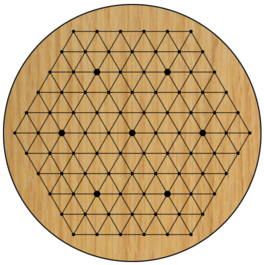
An empty 6×6×6 Badux board
The darker points are star points. They behave the same as any other point on the board, but help you find your way around.
While any board size is possible, Badux standardizes on three sizes, roughly matching the traditional Go board sizes:
| Go board | Points | Badux board | Points |
|---|---|---|---|
| 9×9 | 81 | 6×6×6 | 91 |
| 13×13 | 169 | 8×8×8 | 169 |
| 19×19 | 361 | 12×12×12 | 397 |
Comparing Go and Badux board sizes
Objective
The goal of Badux is to control more area than your opponent. Area consists of empty cells that your stones surround, plus your living stones on the board.
Basic Play
Taking Turns
Black plays first, then players alternate placing one stone at a time on any empty cell of the board. Once placed, stones do not move. A player may also choose to pass instead of placing a stone.
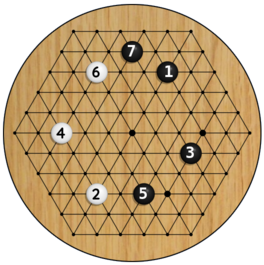
First seven moves of a game. It's White's turn.
Early moves typically establish positions in the corners, since these are the easiest places to control area.
Groups and Connections
On a hex board, each cell has up to six neighbors.
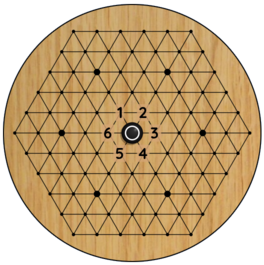
A single-stone group with six neighbors
Stones of the same color that occupy adjacent cells are connected and form a group. This group has fifteen neighbors:
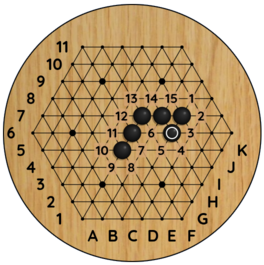
A six-stone group with fifteen neighbors
Liberties
A liberty is an empty cell adjacent to a stone or group. Liberties represent the “breathing room” for your stones. Every neighboring point that is unoccupied is a liberty. So the groups in the previous section have 6 and 15 liberties, respectively. If we begin to surround the groups with White stones, they now have 2 and 3 liberties, respectively:
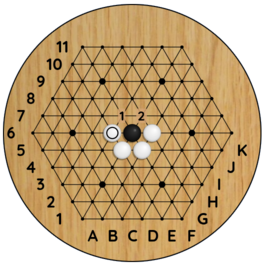
A single-stone group with two remaining liberties
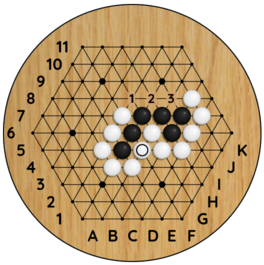
A six-stone group with three remaining liberties
Capture
When a stone or group has no liberties remaining (all adjacent cells are occupied by enemy stones), it is captured and removed from the board. The captured stones become prisoners.
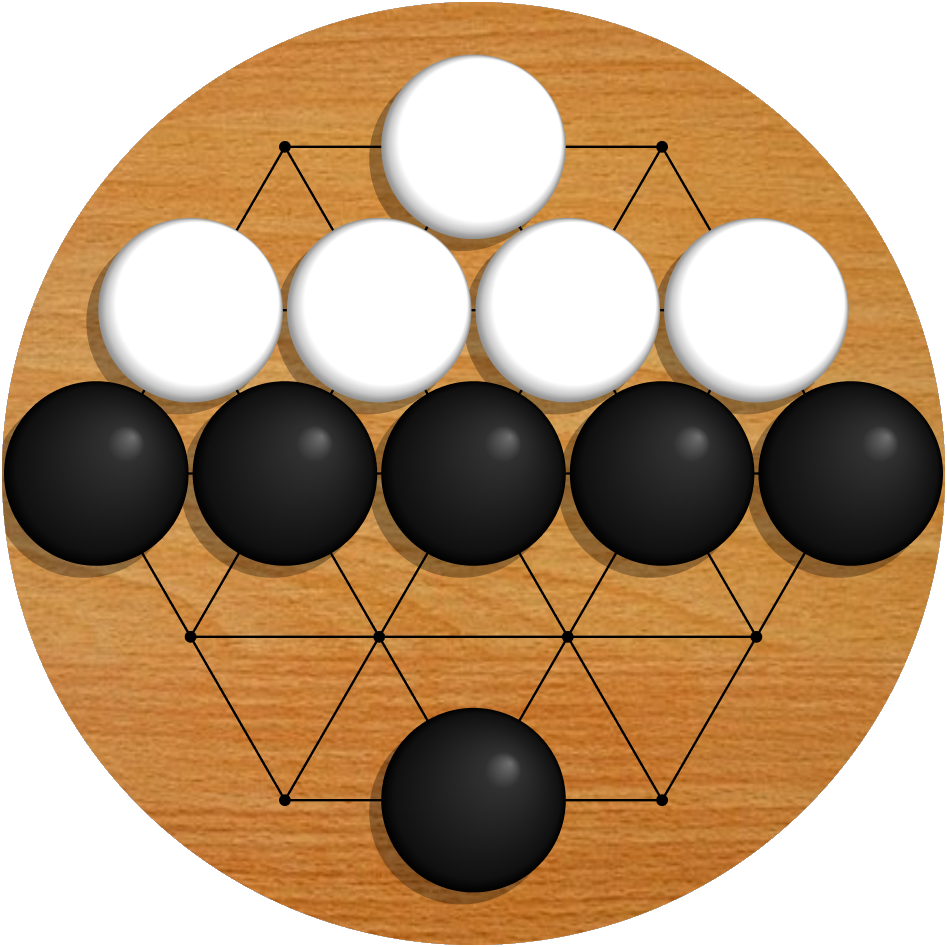
When the Black group has one remaining liberty, it is said to be in atari, and can be captured on the next turn if Black doesn’t respond.
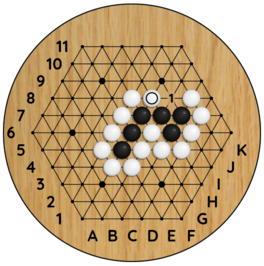
A six-stone group in atari
White plays another stone, removing the group’s last liberty:
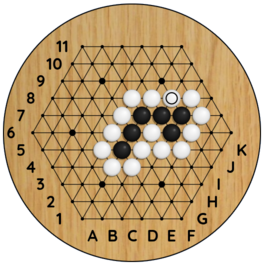
White removes the group's last liberty
The Black group is removed from the board as part of White’s turn:
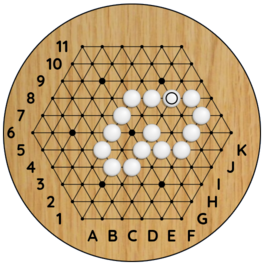
The six-stone Black group is captured
Self-Capture (Suicide)
You may not place a stone in a cell where it would have no liberties, unless doing so captures enemy stones. In other words, suicide is not allowed—you cannot remove your own stones by playing into a position with no liberties.
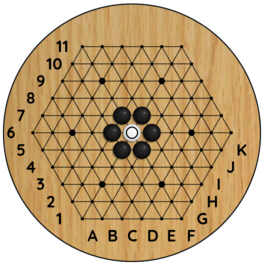
White plays an illegal self-capture move
However, if placing a stone would capture enemy stones and thereby create liberties for your stone, the move is legal. The enemy stones are removed first.
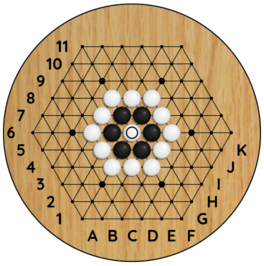
Here, White's move is legal, because it takes away the Black group's last liberty
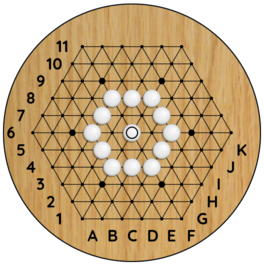
The Black group is captured
Life and Death
Two Eyes
A group is alive (cannot be captured) if it contains two separate internal liberties called eyes. An eye is an empty cell completely surrounded by stones of one color.
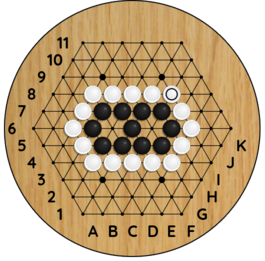
A group with two eyes is alive
If a group has only one eye, the opponent can eventually fill in all external liberties and then capture the group by playing in the eye.
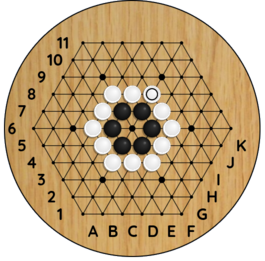
White can play in the middle to capture the one-eyed group
Seki (Mutual Life)
Sometimes two opposing groups share liberties in such a way that neither player can capture the other without losing their own group. This situation is called seki (mutual life). Both groups are considered alive, and the shared liberties score for neither player.
There are two common types of seki:
One-eye seki: Each group has one eye, and they share one dame point between them. Neither player can fill the dame without reducing their group to one liberty, allowing the opponent to capture.
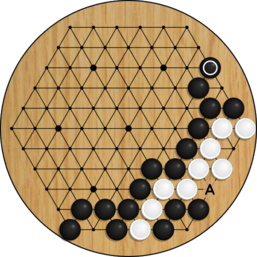
If either player plays at A, they will be captured
No-eye seki: Neither group has eyes, but they share two dame points between them. If either player fills one of the dame, the opponent fills the other and captures.
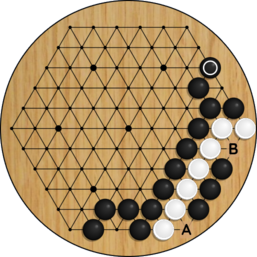
If either player plays at A or B, they will be captured
Living Shapes
A living shape is a shape where the player will be able to form two eyes, even if their opponent gets to play first. Identifying living shapes takes some skill and experience. Here are some examples:
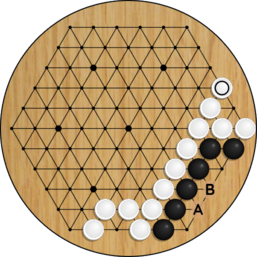
If White plays A, Black plays B to live. And vice-versa.
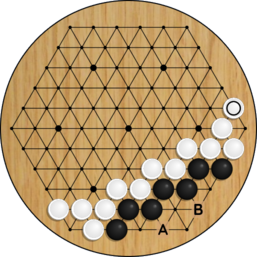
If White plays A, Black must play B to live. And vice-versa.
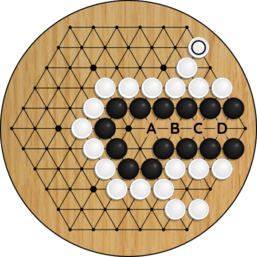
Black can play at A, B, C, or D at any time to live.
End of the Game
The game ends when both players pass consecutively. This typically happens when neither player believes they can gain more territory or capture more stones.
Scoring (Chinese Rules)
Badux Go uses area scoring (Chinese rules). Your score is your area: your living stones, plus the empty cells you surround, plus any dead opponent stones still on the board. The player with the higher score wins.
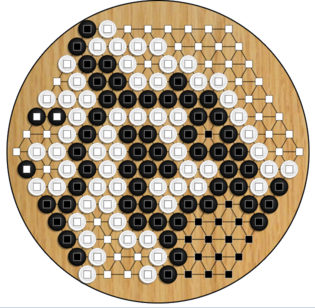
White has 98 points of area, and Black has 71
Komi
To compensate for Black’s first-move advantage, White receives extra points called komi. Badux Go uses 6.5 points of komi, adopted from traditional Go. This seems to work well so far, but may be adjusted as more games are played.
The half point is to avoid ties. In the above example, White has 98 points of area + 6.5 points komi = 104.5 points, and Black has 71 points. White wins by 33.5 points.
Dame
Dame (neutral points) are empty cells that border both Black and White territory. These cells score for neither player and are typically filled in at the end of the game before final scoring.
Summary of Rules
- Black plays first; players alternate turns
- On your turn, place one stone on any empty cell, or pass
- Stones of the same color in adjacent cells are connected
- A stone or group with no liberties is captured and removed
- You may not play a stone that would have no liberties (unless it captures)
- The game ends when both players pass
- Score = your area (stones on board + empty cells you surround)
- Highest score wins (White adds komi)
Differences from Regular Go
If you’re already familiar with Go, here’s what’s different about Badux:
No Hanes
Perhaps the biggest difference between Badux and traditional Go is that there are no hanes. On a square board, players can hane or sometimes make a one-space jump to get ahead of their opponent, or cut them off, in a crawling race.
On a square board, a 3-3 invasion of a 4-4 corner typically leads to an even result. If Black opens 4-4, White can easily invade at the 3-3 and live. But White only has so much territory, and Black gains a lot of influence towards the center.
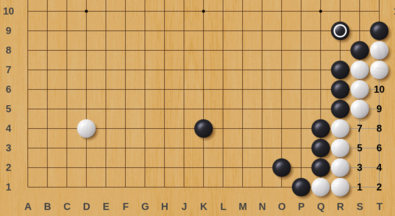
White lives in the corner after a 3-3 invasion
On a hex board, the 3-3 invasion can live a lot larger, since Black cannot hane to contain the group in the corner.
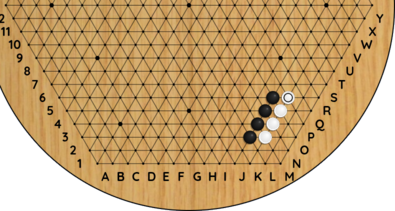
White's 3-3 invasion is already alive after playing 4 stones.
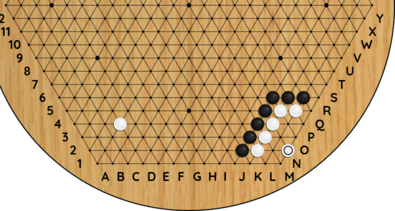
White gets to play away once and still survive
On a square board, a 2-2 invasion of a 3-3 opening cannot live. A 2-2 invasion can live on a hex board, but is probably ill advised, because it gives away too much influence:
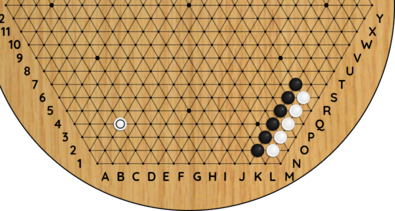
A 2-2 invasion lives with five stones, but gives away too much influence
This suggests that a 4-4 opening on a hex board is sub-optimal, and a 3-3 opening is probably stronger on a hex board than on a square one.
No Cuts
On a square Go board, a diagonal relationship between two stones can be “cut” by an opponent’s stone. On the hex board, there are no diagonals—connectivity is unambiguous. Two stones are either adjacent (connected) or they’re not.
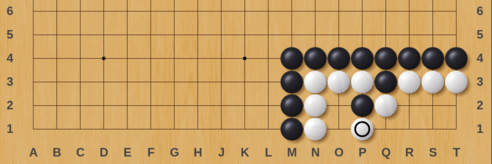
Cutting fights like this are not possible on a hex board
No Simple Kos
The ko rule exists in Go to prevent infinite loops: you cannot immediately recapture a single stone that was just captured. In Badux, the geometry of the hex board means that simple ko situations (single-stone back-and-forth captures) cannot occur. The superko rule (no repeating any previous board position) still applies for theoretical edge cases, but in practice, you won’t encounter ko fights in Badux.
A Learning Tool
Because Badux eliminates hanes, cuts, and kos, it presents the core mechanics of Go in a simplified form. This makes Badux an excellent way to learn the fundamentals—capturing, life and death, and territory—without getting bogged down in some of Go’s more complex tactical patterns. Once you’re comfortable with Badux, transitioning to traditional Go becomes much easier.
Ready to play? Visit BaduxGo.com to start a game, or watch the tutorial video for a visual introduction.